Cheek Issues – Hollow Cheeks, Wrinkles, Brown Spots
Here are the top issues! A more complete discussion can be found in my book, The Surgery-Free Makeover: All You Need to Know for Great Skin and a Younger Face.
Filling out hollow cheeks
Most everyone by age 70 loses some of the rounded contour of their cheeks. Those of us with low body weight may notice hollowing in their cheeks in their 40s. Some see the hollowing more in their temples or in the area right in front of their ears. In any event, if you treat hollow cheeks before they get too severe, you can help to correct the gauntness that comes with hollowing of the cheeks.
The best treatment option for hollow cheeks is Sculptra. You may need two to four treatments approximately 4 to 8 weeks apart, and they will cost approximately $600 to $2,000 per treatment. They take about 4-9 months to stimulate your body’s natural collagen production to reduce some of the hollowness, but the results can be very good. Sculptra is very natural, and it can give a long-lasting correction to hollow cheeks that requires maintenance only once a year after your initial series of injections.
Juvederm Ultra Plus and Perlane, the hyaluronic fillers, are also good for filling in hollow cheeks. They will not promote the growth of significant natural collagen, unlike Sculptra, and you will need to repeat the treatments every 4 to 9 months. But for $600 to $1,200 you can get a good to excellent result.
One other option for filling in hollow cheeks is fat transfer. Some providers will take fat from a part of your body, like your thighs, and put it in your cheeks. I personally don’t recommend fat transfer for hollow cheeks for several reasons. It can be lumpy and irregular, and the irregularities can be hard to fix. It’s also not predictable how long the fat transfer lasts. In some patients it lasts 6 months and in others, years. It can be very expensive considering the unpredictability of the results. And, last, it can cause a great deal of bruising, even requiring a week or two off from work to recover. For these reasons, I personally think Sculptra is a better option.
Sagging cheeks
Sun damage and age tend to naturally weaken the elastic and collagen fibers under the surface of our skin. In the cheek area, this becomes noticeable as sagging skin.
The three options to correct sagging cheeks are Thermage, Sculptra, and the heavier-weight fillers, which are Juvéderm Ultra Plus and Perlane.
Thermage is the radio-frequency skin tightening treatment. A full-face Thermage will cost $2,000 to $3,000 and in approximately 2 to 6 months give you a noticeable but not dramatic tightening. If you are over 50, you may need more than two Thermage treatments. Thermage works best if the sagging in your cheeks is mild to moderate and you are under 55.
Sculptra is also a good option in that it adds volume in the upper cheek area which helps dilute the sagging. Sculptra injections cost from $600 to $2,000 per treatment. You may need two to four treatments approximately 4 to 8 weeks apart. The results are good to excellent, and, as with Thermage, take approximately 6 months to show, primarily because the Sculptra stimulates your body’s natural collagen production.
A more short-term fix for sagging cheeks is to use the heavier molecular weight of the hyaluronic acid fillers. The trade names for these are Juvéderm Ultra Plus and Perlane. These will give immediate results but will not build collagen. They must be repeated every 4 to 9 months. A set of injections in the upper cheeks will cost $450 to $1,200 depending on whether you need one syringe or two.
See Dr Irwin’s Guide to Fillers: Restylane/Juvéderm
Defining and restoring cheekbones
Three main reasons for redefining cheekbones include:
- The area is flattening with age.
- The cheekbones are becoming bony or gaunt looking.
- The skin over the cheekbones is sagging.
The nonsurgical options to define cheekbones are the hyaluronic acid fillers, Restylane and Juvéderm, or Sculptra. Some of my younger patients generally want to get cheekbones that have just a bit more definition. For them, I recommend Restylane/Juvéderm as the most cost-effective solution. With one or two syringes that will last 6 months or more, they can get a nice result for approximately $450 to $1,200. For my older patients, I use the thicker, higher molecular weight forms, called Juvéderm Ultra Plus or Perlane.
Sculptra is more expensive up front—the initial series of injections can run $2,000 to $6,000 for the cheekbones depending on your age and how much filling is needed—but Sculptra lasts much longer than the hyaluronic acid fillers, which means you need less maintenance treatments down the road. Sculptra also stays more even throughout the whole cheekbone area, whereas Restylane and Juvéderm gradually “deflate.”
And lastly, Sculptra improves skin texture and color through its building of natural collagen. Sculptra can be temporarily lumpy or uneven in the hands of an inexperienced injector, so find someone who knows what they are doing. Sculptra also takes about 6 months to achieve the desired result.
You may also have heard of Radiesse®. Radiesse is a filler composed of calcium, hydroxylapatite crystals, a naturally occurring substance similar to cartilage. Radiesse can result in an immediate and long-lasting correction that can last for even 12 to 15 months. But, Radiesse’s safety profile is not as good as that of Restylane or Juvéderm. And because Sculptra promotes collagen, you don’t get the healthy “glow” with Radiesse that you do with Sculptra. Until there is more long-term safety information on Radiesse, I recommend to my patients that they stick with Restylane/Juvéderm or Sculptra.
Wrinkles on the cheeks
There is no single, great, non-surgical option that can eliminate cheek wrinkles. Even combining different treatments that I will give you below, you can realistically expect a 40 to 80% improvement in cheek wrinkles.
The least expensive treatment option is a TCA chemical peel for wrinkles. This is a chemical peel that should be done only by a dermatologist. But, it can give a good result and costs approximately $400 to $1,500 for a series of three to five peels.
If the TCA peel does not give you the results you want, then you will need a laser treatment for your wrinkles. The most promising development here is the fractional lasers, and they have produced some good results for cheek wrinkles. You will probably need a series of three to five treatments at a cost of $2,000 to $5,000 total. The treatments take place over about 6 months and require maintenance once every year or two.
The Fraxel is a non-ablative laser that has a 1-2 day downtime, and the ablative or re-surfacing lasers, like the Active FX or Affirm, have a 4-8 day downtime.
See Dr. Irwin’s Guide to Fractional Lasers
Another, slightly less expensive, option is to use a collagen-building laser. Some of the brand names for these are CoolTouch®, Smoothbeam, Aramis™, or Planet Galaxy. From $1,000 to $3,000 will get you a series of three to five treatments from these collagen-building lasers. Over 6 months or more, you should notice a stimulation in the production of collagen which will help to reduce some of the cheek wrinkles and restore a little bit of glow to your cheeks.
Carbon dioxide resurfacing laser for wrinkles is the gold standard but carry risks of scars or pigment changes. Plan on 2 weeks in the house and several months of pink to red after that. The red can last much longer in some patients. Still, if you have a lot of wrinkles and a good laser dermatologist who is experienced, a very nice result can be obtained in one treatment.
Fractional lasers are attempting to provide the same result but with less downtime and in a series of three to five treatments. And new fractional lasers are coming on the market this year. It will be interesting to see if they can match the result of the carbon dioxide lasers. I’ll keep you posted!
Redness and dilated or broken blood vessels
Having redness or broken blood vessels on your cheeks does not necessarily mean that you are an alcoholic, contrary to popular myth. Often people with Celt genes develop redness or even broken blood vessels on and around the cheeks or nose. This can be caused by rosacea, sun damage, or even some systemic diseases, like lupus. You will need a doctor to help you figure out the cause of your redness. If redness is due to rosacea, the first step is to look at lifestyle changes, like diet and exercise.
If the redness is due to sun damage, or you have rosacea that is under control, you may want to consider IPL/photorejuvenation laser treatments to reduce the redness. These treatments cost $1,000 to $2,500 for a series of five treatments. The results are often excellent and take effect in about 6 months, as you complete your series of 5 treatments. You’ll need maintenance treatments once or twice a year.
Brown spots from age and sun damage
Brown spots are essentially sun damage. Many of us get freckles when we are younger, but as we age they get larger and often darker. You should have your dermatologist examine your skin before any cosmetic treatments to make sure you don’t have a skin cancer.
The first thing to do about brown spots and age spots is to prevent more of them by applying sunscreen daily. Make sure you use a broad spectrum sunscreen that protects you from UVA radiation by having at least 5-10% zinc or titanium or 3% mexoryl.
You can also try over-the-counter “bleaching” creams if your age spots are localized or not too bad. “Bleaching” creams do not really bleach but they do temporarily decrease the production of brown pigment in your skin. Drugstore bleaching creams contain 2% hydroquinone and are not very effective. They generally cost under $50.
Keep in mind that continued sun exposure will stimulate the growth of brown spots, so bleaching creams will not protect you against the regrowth of brown spots or the development of new spots on your cheeks and face. Only sunscreen can do that.
Prescription bleaching creams all contain 4% hydroquinone plus or minus other ingredients like hydroxy acids, sunscreens, or tretinoin. These prescription strength creams are more effective but still temporary. For some patients who are allergic or don’t want to use hydroquinones, I have also used plant-based bleaching creams. These ingredients are ones like arbutin, thymol, and kojic acid. They seem to be less effective than the prescription creams.
Microdermabrasion and light peels are also options for mild to moderate brown spots. A good aesthetician can perform microdermabrasion or a low-strength peel, and these can often give good results, but need to be done in a series, usually to 3-6, to be effective. The cost of chemical peels vary widely, but you can expect a series to cost $250-$800 depending on how many are done and what is used.
A medium peel, like a TCA peel, can also give good to excellent results but should be done by an experienced dermatologist.
The most effective treatment option for brown spots is a series of laser treatment. This is also, unfortunately, the most expensive.
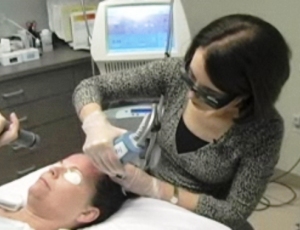
An IPL (also called photorejuvenation) will usually give excellent results. A series of five treatments will cost you anywhere from $1,500 to $2,500. In addition to treating brown spots, often times an IPL will also reduce any redness, stimulate some mild collagen growth, and add to your skin’s glow. You will need maintenance treatments when brown spots reappear, usually once or twice a year.
The fractional lasers are newer and are one of the best options if you also have wrinkles or acne scarring. Many clinics, including ours, are reporting excellent results. The non-ablative fractional lasers, like the Fraxel, have a 2-day downtime, and cost $2,000 to $6,000 for a series of 3 to 5 treatments. Some people see results quickly with the Fraxel, but results will improve over 2-6 months. The ablative fractional lasers, like the Active FX, have a 4-8 day downtime, and cost $1,000 to $2,000 per treatment.
Brown spots or splotches due to melasma
If you have larger splotches of brown spots that appear on the cheeks, jaw line, upper lip, or forehead they may be due to melasma from pregnancy, oral contraceptives or other hormones. If you think you might have melasma, you should see a dermatologist before trying any treatment options. This can be a tough problem to treat and the sooner you start the better.
You should also consult a dermatologist before any laser treatments for melasma. Some lasers can make melasma worse. One promising development in this area is the fractional lasers, which may be helpful.
Lumps, bumps, and moles
You should see a dermatologist if you have any lumps, bumps, or moles on your cheeks that you want treated. Some growths are precancerous or cancerous, so make sure that a dermatologist checks anything growths that you think have changed or are suspicious. The various lumps, bumps and moles we have are all treated in differently, depending on what they are. It is in your best interest to see your doctor and have them recommend the correct treatment plan.
Next, learn about Jaw Line and Chin Issues
See Dr. Irwin’s expert answers to other reader’s questions on Cheeks:
What can I do about uneven cheeks?
What is the best filler for hollowing cheeks?